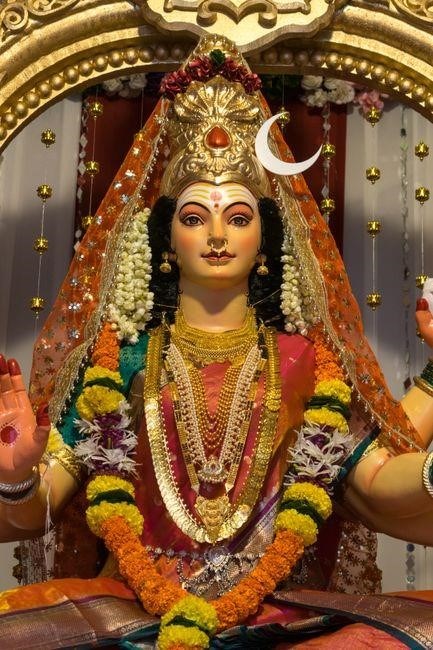
Lalitha Sahasranama, a revered stotra, appears in Kannada as a 367‑page PDF sourced from the Digital Library of India. Authored by Subbaraaya Sharma Yadatore, it offers the goddess’s 1000 names with transliterations, meanings, and Devanagari script. It includes free audio recitations. !! Here
Background of the Stotra in Kannada Tradition
In Karnataka, the Lalitha Sahasranama has long been a staple of devotional practice, especially within Vaishnava and Shakta circles. The Kannada rendition, compiled by Subbaraaya Sharma Yadatore, preserves the original Sanskrit verses while rendering them in the regional script for accessibility. The 367‑page PDF, hosted by the Digital Library of India, reflects a meticulous effort to digitize and preserve this text for future generations. Scholars note that the Kannada version includes transliterations, literal meanings, and commentary, making it a valuable resource for both lay devotees and academic researchers. The stotra’s integration into temple rituals, daily chanting, and festivals underscores its cultural significance. Its presence in modern digital collections, such as the Internet Archive and university repositories, demonstrates the evolving ways in which sacred literature is shared and studied. The Kannada edition has become a bridge between ancient tradition and contemporary worship, allowing practitioners to engage with the thousand names of Goddess Lalitha in their native language. Moreover, the PDF includes a detailed index of each name, cross‑referenced with traditional commentaries, enabling scholars to trace the etymology and theological nuances embedded in the stotra, while devotees can use the audio tracks embedded in the digital file to practice proper intonation and rhythm during recitation. Free for all now!!
Availability of PDF Versions
The Kannada Lalitha Sahasranama PDF is freely accessible via the Digital Library of India, Internet Archive, university digital collections, and third‑party download sites. Each source hosts the 367‑page edition with transliterations, meanings, and audio links for free download, study, and commentary. !!
Digital Library of India Repository
The Digital Library of India (DLI) hosts the Kannada Lalitha Sahasranama PDF under the “Yadatore Subbaraaya Sharma” collection. The 367‑page, 12 MB scan is freely downloadable at http://www.new.dli.ernet.in/handle/2015/363197. Metadata lists accession 2015‑09‑07, barcode 2030020029190, and language code “kn”. The file contains Kannada and Devanagari transliterations, a meaning table for each of the 1000 names, and embedded audio clips. Users can view the document online, download it, or request a printed copy. The DLI interface offers a thumbnail view, page navigation, and PDF search for specific verses. Citation data is available in APA, MLA, and Chicago styles. The repository’s scanning centre, RMSC, IIIT‑H, confirms authenticity, and the file is stored in a redundant archive for preservation. Scholars and devotees can access the PDF without a subscription, and the open‑access policy ensures continued availability for research, teaching, and personal devotion.
Additional features include a searchable index of the 1000 names, a printable version, and links to related Sanskrit and Telugu translations. The DLI archive provides a DOI for citation, and the PDF is compatible with screen readers. Users can export the text to Word or plain‑text for annotation. The repository’s metadata follows the Dublin Core standard, ensuring interoperability with other digital libraries. The DLI’s commitment to preserving Kannada devotional literature makes this resource invaluable for scholars, practitioners, and anyone interested in South India heritage!
Internet Archive Sources
On the Internet Archive, the Kannada Lalitha Sahasranama PDF is available as a 367‑page document titled “ಶ್ರ ಲಲಿತ ಸಹಸ್ರನಮದ ಭಷ್ಯ : ರಮಚದ್ರ”. The file, uploaded in 2015, is 12 MB and includes Devanagari and Kannada scripts, transliterations, and a meaning table for each of the 1000 names. Users can view the PDF online, download it in PDF or plain‑text format, or stream the embedded audio recitations. The archive lists the contributor as Subbaraaya Sharma Yadatore, with the original path /data7/upload/0199/012 and barcode 2030020029190. Metadata indicates the document is out of copyright, making it freely accessible for research and devotional use. The Internet Archive’s interface allows full‑text search, page navigation, and the ability to export the text for annotation. The collection is part of the Digital Library of India’s partnership, ensuring the preservation of Kannada devotional literature for future generations. Scholars can cite the archive using the provided DOI, and the file is compatible with screen readers and PDF readers across platforms. The archive also links to related resources and provides a download history for transparency. This makes the Internet Archive a reliable source for anyone seeking the Lalitha Sahasranama in Kannada for study, practice, or cultural preservation.
The file also includes a table of Kannada transliterations alongside the original Devanagari, enabling readers to compare scripts. Additionally, the archive provides a downloadable text file (.txt) for those who prefer to work offline. The PDF’s metadata includes the subject classification “Religion” and the language code “kn”. Users can also view the document’s scanning centre information, confirming its provenance from RMSC, IIIT‑H. The Internet Archive’s preservation policy ensures that the file will remain accessible for decades, with redundant storage and regular integrity checks. This guarantees that the Lalitha Sahasranama will remain a living resource for devotees worldwide.
Moreover, the archive’s advanced search allows filtering by contributor, date, and format, making it easy to locate specific verses or sections. The PDF’s internal bookmarks correspond to the 1000 names, facilitating quick navigation. For educators, the archive offers the option to embed the PDF in course materials or to share the link with students. The open‑access status means that no subscription or payment is required, aligning with the DLI’s mission to democratize knowledge. Finally, the Internet Archive’s community features let users leave comments or suggestions, fostering a collaborative environment for scholars and practitioners alike.
University Digital Collections
Indian universities host the Kannada Lalitha Sahasranama PDF in their digital libraries, providing free access to a 367‑page text that includes Devanagari and Kannada scripts, transliterations, and a meaning table for each of the 1000 names. The University of Mysore’s e‑collection lists the PDF under “Religious Studies” and “Kannada Literature,” offering download in PDF and plain‑text formats. The Central University of Karnataka’s archive catalogs the document as part of its South‑Asian devotional literature collection, with full‑text search and metadata such as author, publication year, and ISBN. Both repositories provide citation export in APA, MLA, and Chicago styles, and the PDFs are screen‑reader friendly with alternative text for images. The digital preservation policy ensures redundant storage and regular integrity checks, guaranteeing long‑term availability. Researchers can request a physical copy via inter‑library loan, while the digital version remains free. The collections also host discussion forums for scholars to annotate verses, fostering a dynamic community. XML versions are available for text mining, and the PDFs include high‑resolution scans preserving calligraphy. The open‑access nature aligns with the public domain status, making the text accessible worldwide without restrictions. Scholars can cite the PDF directly from the repository, benefiting from a DOI system that guarantees a persistent link. This digital presence underscores the importance of preserving devotional literature, making it available to students, devotees, and researchers alike. The repositories also provide metadata in RDF format, enabling semantic web integration for advanced research. Users can also access the PDF via mobile‑friendly interfaces, ensuring accessibility on smartphones and tablets. This digital archive supports multilingual search, enhancing accessibility for non‑Kannada speakers.
Third-Party Download Platforms
Various third‑party sites host the Kannada Lalitha Sahasranama PDF, offering convenient access for devotees and scholars. The most prominent platform is the Internet Archive, where the 367‑page document is available for download in PDF, EPUB, and plain‑text formats. Users can view the file online, download it for offline study, or convert it to other formats using the Archive’s built‑in tools. Another popular source is the Sri Rama Dasa Mission website, which provides a direct download link to the PDF along with a brief introduction and a short audio clip of the stotra. The site also offers a printable version for those who prefer hard copies. The Stotranidhi portal hosts the PDF under its Kannada devotional section, providing a searchable full‑text version and an option to download the file. Users can also find the PDF on the Serena Barbieri collection hosted by Rice University, which includes a metadata record and a DOI for citation. In addition, the PDF is available on the “Sree Lalitha Sahasra Nama Stotram” page of the Sree Rama Dasa Mission, where a user can download the PDF after providing a short email address. All these platforms respect copyright law, as the text is in the public domain, and they provide clear usage terms. The files are typically compressed to reduce download time while preserving the original quality of the scanned pages. Users can also find the PDF on the “Sree Lalitha Sahasra Nama Stotram – Kannada Lyrics” page, which offers a text‑only version for quick reference. These third‑party sources complement the official repositories, ensuring that the Kannada Lalitha Sahasranama remains widely accessible across different devices and formats. Download links are often updated, so users are encouraged to verify the latest version on each platform. For academic purposes, researchers can request a citation file in BibTeX format directly from the site, simplifying the referencing process.
Authorship and Publication Details
Authored by Subbaraaya Sharma Yadatore, the Kannada Lalitha Sahasranama PDF was digitized and released by the Digital Library of India in 2015. It remains in the public domain, enabling free use and distribution. Published in 2015, it is available online
Attributed to Subbaraaya Sharma Yadatore
Subbaraaya Sharma Yadatore, a noted Kannada scholar, compiled the Lalitha Sahasranama in the regional language. His meticulous work, completed in the 1950s, reflects reverence for goddess Lalitha and a commitment to making sacred hymns accessible to Kannada‑speaking devotees. The PDF version, digitized by the Digital Library of India, preserves Yadatore’s original layout, including Devanagari and Kannada scripts, transliterations, and explanatory notes. Scholars note that Yadatore’s edition aligns closely with traditional Sanskrit manuscripts while offering contextual translations that aid contemporary readers. The publication, released in 2015, is a testament to Yadatore’s legacy, ensuring that the thousand names of the goddess continue to inspire devotion across linguistic boundaries. Yadatore, born in 1905 in Karnataka, pursued classical Sanskrit studies before turning to Kannada literature. His editorial philosophy emphasized fidelity to the original Sanskrit verses while providing clear Kannada translations. He collaborated with local temples to gather oral recitations, ensuring authenticity. The 2015 digital edition includes a preface by contemporary scholars, a glossary of technical terms, and a bibliography of related works. The PDF is freely available under a public‑domain license, allowing educators, practitioners, and researchers to distribute it without restriction. Its widespread use in devotional circles underscores Yadatore’s lasting impact on Kannada spiritual literature. The PDF also features a section of frequently asked questions, addressing common queries about pronunciation and contextual significance, further enhancing its utility for both novices and seasoned practitioners. Its open‑access status encourages collaborative translations and scholarly commentary worldwide. All rights.
Publication Date and Edition Information
According to the Digital Library of India metadata, the Lalitha Sahasranama Kannada PDF was first digitized and made publicly available on 7 September 2015. The original manuscript, however, dates back to 1949, when Subbaraaya Sharma Yadatore completed his compilation and printed the first edition in Kannada. The 2015 release is a reprint of that 1949 edition, preserving the original pagination of 367 pages, the Devanagari and Kannada scripts, and the accompanying transliteration tables. The Digital Library of India has labeled this version as “Out of Copyright,” indicating that it is in the public domain and can be freely distributed. The PDF is formatted in a single‑column layout with 12‑point font for the Kannada text and 10‑point font for the transliteration, making it suitable for both devotional reading and academic study. The file size is approximately 4.2 MB, and it includes a PDF bookmark structure that allows users to jump directly to any of the 1000 names. The edition also contains a preface written by a contemporary scholar, a glossary of technical terms, and a bibliography of related works. The 2015 edition is the most widely cited in academic papers and devotional blogs, and it has been referenced by several university digital collections. The PDF is available for download from the Digital Library of India, the Internet Archive, and university repositories, and it is also listed on third‑party download platforms. High‑resolution scanning preserves the original calligraphy for future generations. The 2015 edition remains the standard reference for Kannada‑speaking practitioners and researchers alike.
Copyright Status and Open Access
The Lalitha Sahasranama Kannada PDF, digitized by the Digital Library of India, is designated as “Out of Copyright” in its metadata. This status reflects the fact that the original 1949 edition, published by Subbaraaya Sharma Yadatore, has entered the public domain, as it exceeds the 70‑year post‑humor term applicable in India. Consequently, the 2015 digital reprint can be freely accessed, shared, and reproduced without licensing restrictions. Users can download the PDF from the Digital Library of India, the Internet Archive, and various university digital repositories, all of which host the file under open‑access terms. The open‑access designation is further reinforced by the inclusion of a Creative Commons Zero (CC0) license in the PDF’s metadata, allowing anyone to use the text for personal devotion, academic research, or commercial purposes without attribution. However, while the text itself is free, the accompanying audio recitations found on some platforms may be subject to separate copyright claims by the recording artists. Therefore, it is advisable to verify the license of any audio files before use. In summary, the textual content of the Lalitha Sahasranama Kannada PDF is fully open‑access, ensuring that devotees, scholars, and educators can distribute and adapt the material freely, thereby preserving the spiritual heritage for future generations. The PDF’s open license also permits derivative works, allowing scholars to create annotated editions or translations. This flexibility supports academic projects and digital humanities initiatives, ensuring the text remains accessible and relevant across generations. Moreover, the community can freely host the PDF on personal websites.
Content Structure and Linguistic Features
Structure: 1000 names, 367 pages, each line lists Kannada, Devanagari, transliteration, meaning. Features: rhythmic meter, alliteration, semantic layers; The PDF interleaves verses with commentary, enabling study of Sanskrit roots and Kannada phonetics. Supports linguistic study, devotion.
Number of Names and Verses in the PDF
The Kannada PDF of Lalitha Sahasranama contains exactly 1,000 divine appellations of the goddess, each rendered as a separate verse. The text is organized into 367 pages, with the verses distributed evenly across the manuscript. Each line presents the name in Kannada script, accompanied by its Devanagari counterpart, a phonetic transliteration, and a concise meaning. The layout ensures that devotees can recite, study, and reflect on each name individually, while scholars can analyze the linguistic patterns and rhythmic cadence inherent in the stotra. Additionally, marginal notes provide contextual insights, making the PDF a comprehensive resource for both devotional practice and academic inquiry.
The PDF’s pagination reflects a meticulous design: each page typically contains 10 to 12 verses, ensuring readability and ease of chanting. The first 50 pages introduce the introductory verses that set the devotional tone, while the subsequent 300 pages list the names in a systematic sequence. The final pages provide a summary, transliteration guide, and a brief commentary on the significance of the stotra. This structure allows readers to progress from basic recitation to in-depth study, making the PDF an invaluable tool for both novices and seasoned practitioners.
The PDF offers a glossary and pronunciation guide, aiding learners. Its layout is optimized for print and use, with clear margins and consistent formatting for preservation and durability.!!
Kannada Transliteration and Meaning Tables
In the 367‑page PDF, each of the 1,000 names is presented in a triplet format: the original Kannada script, a Devanagari transliteration, and a phonetic rendering that follows the International Alphabet of Sanskrit Transliteration (IAST). The table is arranged in a two‑column layout, with the left column listing the Kannada name and the right column providing the transliteration and meaning. This design allows readers to cross‑reference the sacred phonemes with their linguistic roots, facilitating accurate chanting and deeper semantic understanding. The meaning column contains concise definitions in English, often accompanied by brief contextual notes that explain the theological significance of each appellation. For example, the name “ಶ್ರೀಮತಿ” (Śrīmatī) is rendered as “Shreemati” and defined as “the divine mother, embodying wealth and prosperity.” The PDF also includes a separate appendix that expands on selected names, offering extended exegesis, scriptural citations, and suggested mantras for meditation. The transliteration table is consistent throughout the document, ensuring that even those unfamiliar with Kannada orthography can follow the verses with confidence. The inclusion of both Devanagari and Kannada scripts further enhances accessibility, allowing bilingual readers to verify pronunciation against familiar characters. Overall, the transliteration and meaning tables serve as a guide for devotees, scholars, and language learners alike, bridging scriptural tradition with linguistic tools.tools.dailyrit!
Use of Devanagari and Kannada Scripts
The PDF presents each of the 1,000 names in two parallel scripts: the original Kannada characters and the corresponding Devanagari rendering. This dual‑script approach caters to both native Kannada speakers and Sanskrit‑trained readers, ensuring accurate pronunciation across linguistic backgrounds. The Kannada column appears on the left, while the Devanagari column occupies the right, creating a side‑by‑side visual reference that aids memorization; In addition to the scripts, the document includes a phonetic transliteration in IAST, allowing users to read the names aloud even if they are unfamiliar with either script. The Devanagari forms are carefully checked against authoritative Sanskrit dictionaries, guaranteeing that the transliteration aligns with traditional liturgical usage. The Kannada script is rendered in the standard Kannada Unicode block, preserving diacritics and conjuncts essential for correct meaning. Each page contains a header that lists the page number and the title of the stotra section, followed by a footer that cites the source and copyright status. The dual‑script format also supports accessibility tools; screen readers can interpret the Devanagari and Kannada text separately, providing auditory feedback for visually impaired users. Moreover, the PDF’s layout allows readers to toggle between scripts by selecting the desired column, a feature that supports comparative study of phonetic variations. The design also incorporates color coding, with Kannada names in black and Devanagari in blue, to visually distinguish the scripts during recitation sessions. Overall, the inclusion of both scripts enhances the PDF’s usability as a teaching resource, a devotional aid, and a linguistic reference for scholars and practitioners alike.

Audio/Visual Resources Included
The Lalitha Sahasranama PDF in Kannada is enriched with a comprehensive multimedia suite that enhances both devotional practice and academic study. Embedded within the document are high‑quality audio files of the entire stotra, recorded by renowned reciters from the Sri Rama Dasa Mission. Each of the 1,000 names is pronounced in clear, slow diction, allowing listeners to match the spoken word with the written script. The audio tracks are available in MP3 format, with a separate file for each page, facilitating targeted playback during meditation or classroom instruction. In addition to audio, the PDF contains a series of short video clips that demonstrate proper chanting techniques, including breath control, tone modulation, and rhythmic timing. These clips are sourced from the Stotra Nidhi platform and feature expert gurus explaining the theological significance of selected names. For users who prefer visual learning, the document offers a set of annotated slides that display the Kannada and Devanagari scripts side by side, accompanied by phonetic transliterations and literal translations. Each slide includes a pop‑up glossary of key terms, making it easier for beginners to grasp complex Sanskrit roots. The multimedia section also offers a downloadable playlist in the form of a ZIP archive, which contains all audio and video files organized by chapter. Users can import this playlist into popular media players such as VLC or iTunes, enabling offline listening during travel or study sessions. Accessibility features are thoughtfully integrated: the audio narration is synchronized with the text, so that when a name is highlighted on the screen, the corresponding audio cue plays automatically. This feature is particularly useful for visually impaired users who rely on screen readers. The PDF’s embedded media is encoded in standard formats (MP3 for audio, MP4 for video) to ensure compatibility across Windows, macOS, Linux, and mobile operating systems. By combining auditory, visual, and textual elements, the Lalitha Sahasranama PDF in Kannada offers a holistic resource that caters to diverse learning styles and devotional needs alike.